Why Do Virtual Airlines Score Your Flights?
One of the things that separates a virtual airline from casual flight simulation is accountability. When you fly with a virtual airline like JetStream Virtual, every flight is tracked, evaluated, and scored. This is not about punishment, it is about progression. Scoring gives your flights meaning, provides measurable goals to work toward, and creates a sense of accomplishment when you execute a difficult approach perfectly or manage your fuel with precision.
Think of it like a video game's progression system applied to realistic aviation. Every departure and arrival is an opportunity to demonstrate your skills, and your cumulative performance shapes your pilot profile, rank, and reputation within the airline. Whether you are a brand-new first officer or a seasoned captain with hundreds of hours, the scoring system gives every flight a purpose.
What Is a PIREP?
At the heart of every virtual airline's scoring system is the PIREP, a Pilot Report. In real aviation, PIREPs are reports filed by pilots to share information about flight conditions. In the virtual airline world, a PIREP is a complete record of your flight from gate to gate.
When you fly with JetStream Virtual, the flight logger automatically generates your PIREP. It records:
- Departure and arrival airports, confirming you flew the assigned route.
- Flight time, total block time from pushback to parking.
- Fuel consumption, how much fuel you burned versus what was planned.
- Route adherence, whether you followed the filed flight plan or deviated significantly.
- Landing data, your touchdown rate (vertical speed at landing), centerline tracking, and approach stability.
- Flight phases, automatic detection of each phase from preflight through taxi, takeoff, climb, cruise, descent, approach, landing, and on-block.
Once your flight is complete and you arrive at the gate, the PIREP is compiled and submitted to JetStream's system. From there, the scoring engine evaluates your performance across multiple criteria.
How Flights Are Scored
JetStream Virtual's scoring system evaluates your flight across several key performance areas. Each area contributes to your overall flight rating, giving you a comprehensive picture of how well you flew.
Landing Rate
Your landing rate, measured in feet per minute (fpm) of vertical speed at touchdown, is the most visible and satisfying metric. A smooth landing is not just about comfort; it reflects good energy management, proper approach speed, and precise flare technique.
- Excellent (under -100 fpm): A greaser. Passengers would applaud. These are rare and rewarding.
- Good (-100 to -200 fpm): A professional landing well within normal airline parameters.
- Acceptable (-200 to -400 fpm): Firm but safe. Most real-world airline landings fall in this range.
- Hard (over -400 fpm): A rough touchdown that would raise eyebrows in the cabin and may trigger a maintenance inspection.
- Dangerous (over -600 fpm): This is aircraft damage territory. Scores are significantly penalized.
Keep in mind that chasing extremely soft landings is not always realistic. Real airline pilots prioritize landing in the touchdown zone with proper speed, a -180 fpm landing on centerline is better airmanship than a -50 fpm float that eats up half the runway.
Fuel Efficiency
How well you managed your fuel compared to the planned fuel burn matters. Flying with an accurate SimBrief OFP and sticking close to your planned fuel figures demonstrates disciplined flying. Significant over-burn might indicate you flew at an incorrect altitude, carried excessive speed, or forgot to manage your step climbs. Under-burn could mean you cut corners on the route or flew lighter than planned.
The scoring system compares your actual fuel consumption against the OFP's predicted trip fuel. Small deviations are expected and tolerated, real-world flying always involves minor fuel variations due to weather and ATC routing. Large deviations, however, will affect your score.
Time Accuracy
Arriving close to your scheduled time demonstrates good planning and execution. Virtual airlines operate on real airline schedules, and part of the simulation is maintaining that schedule as closely as possible.
The scoring system measures the difference between your planned flight time (from the OFP) and your actual block time. A few minutes of deviation is normal, ATC delays, weather deviations, and holding patterns all affect timing. But if you arrive 30 minutes early because you flew at Mach 0.90 in a 737, or 45 minutes late because you forgot to set your cruise speed, your score will reflect that.
Violations and Penalties
The flight logger monitors for specific violations during your flight that result in score deductions. These are designed to catch unsafe or unrealistic flying behaviors:
- Overspeed: Exceeding the aircraft's maximum operating speed (VMO/MMO) or flying above 250 knots below 10,000 feet.
- Excessive bank angle: Banking beyond safe limits during cruise or approach phases.
- Unstable approach: Crossing approach gates with excessive speed, altitude deviation, or descent rate.
- Lights and configuration: Flying without appropriate lights (landing lights below 10,000, beacon during engine operation) or failing to extend gear and flaps for landing.
- Taxi speed: Exceeding ground speed limits while taxiing at the airport.
- Parking brake: Failing to set the parking brake at the gate, or releasing it before engine start.
Violations are not meant to be punitive, they are learning tools. Every violation appears in your post-flight summary with an explanation, so you know exactly what happened and when. Over time, you will develop habits that naturally avoid these issues, and your scores will improve as a result.
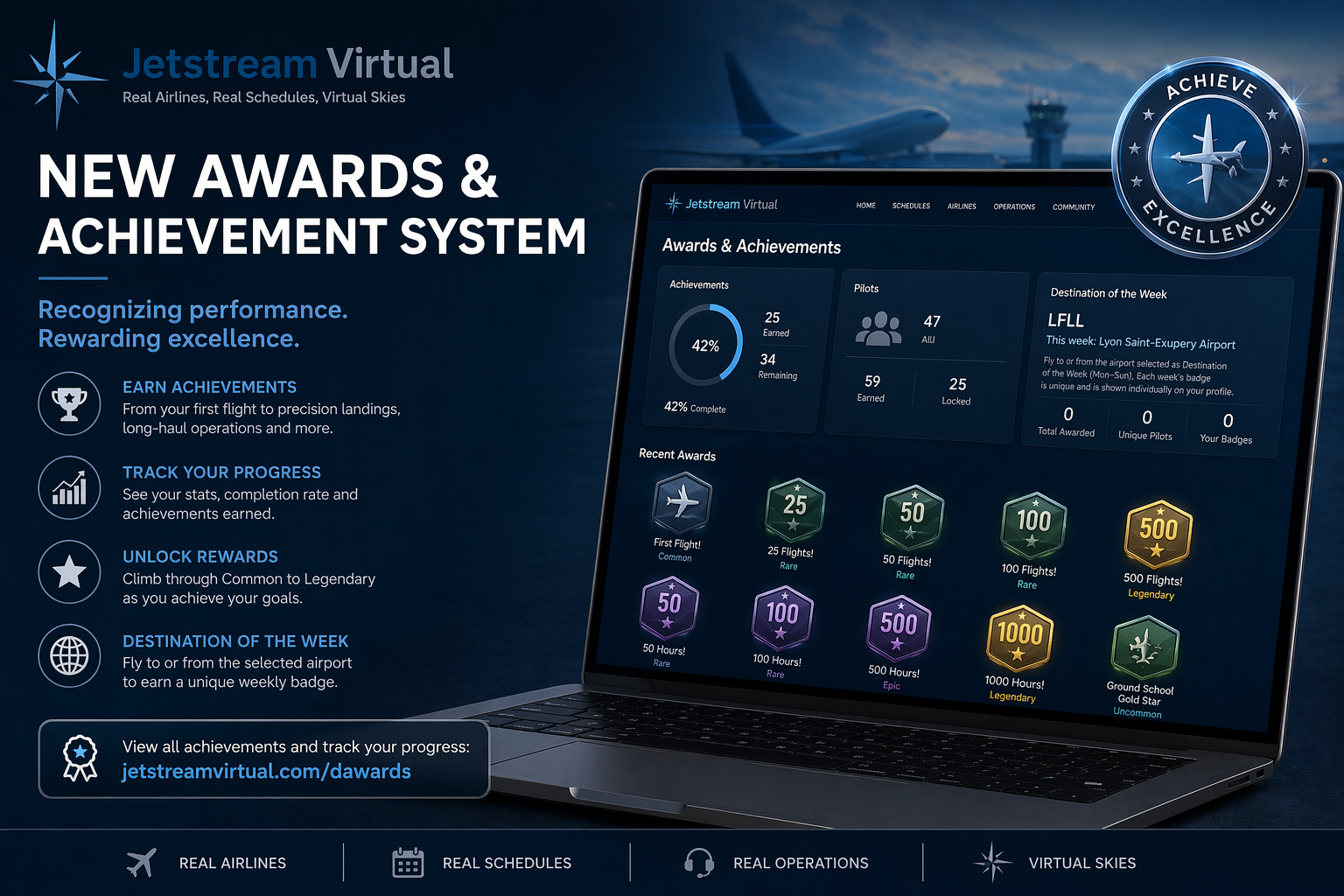
Achievements and Awards
Beyond individual flight scores, JetStream Virtual recognizes cumulative accomplishments through an achievements and awards system. These milestones reward consistency, exploration, and skill development:
- Flight hour milestones: Awards for reaching 50, 100, 250, 500, and 1,000 hours of logged flight time.
- Route completion: Recognition for flying specific route networks or visiting all airports in a region.
- Perfect flights: Awards for completing flights with no violations and exceptional scores across all categories.
- Aircraft type ratings: Logging a minimum number of hours in specific aircraft types to demonstrate proficiency.
- Consistency awards: Flying regularly over weeks and months, maintaining an active presence in the airline.
Achievements give you long-term goals beyond the next flight. They encourage you to explore new routes, try different aircraft, and push your skills in ways you might not otherwise attempt.
Rankings and Progression
Your accumulated flight scores, hours, and achievements feed into JetStream Virtual's ranking system. As you log more flights and build your track record, you progress through pilot ranks, from Junior First Officer through First Officer, Captain, and Senior Captain.
Rank progression is not just cosmetic. Higher ranks unlock access to larger aircraft and more complex routes. A new pilot might start on short-haul domestic flights in a narrow-body aircraft, while an experienced captain can bid on long-haul international routes in widebody jets. This creates a natural progression arc that mirrors real airline career development.
The leaderboard lets you see how your performance compares with other pilots in the airline. It is a friendly competition, not about being the best, but about motivating each other to improve. Seeing another pilot achieve a perfect score on a route you fly regularly is a great motivator to refine your own technique.
Why Scoring Makes Virtual Airlines More Engaging
Without scoring, a virtual airline flight is just a point-to-point trip in a simulator. With scoring, it becomes a structured experience with feedback, goals, and a sense of progression. Every flight teaches you something, maybe your approaches are consistently too fast, or your fuel management on long-haul flights needs work, or you keep forgetting to switch on your landing lights during descent.
The scoring system surfaces these patterns and gives you concrete metrics to improve. It transforms passive flying into active skill development. And when you nail a perfect flight, smooth landing, fuel on target, no violations, on schedule, the satisfaction is genuinely rewarding.
Start Building Your Pilot Record
JetStream Virtual's scoring system is designed to reward good airmanship, not penalize mistakes. Every pilot starts somewhere, and your early flights are learning opportunities. As you gain experience, your scores will naturally improve, your rank will advance, and your pilot profile will tell the story of your growth.
Ready to see how you score? Join JetStream Virtual and fly your first tracked flight. The flight logger handles all the data collection, you just focus on flying. After landing, review your detailed post-flight summary, see where you excelled, identify areas to work on, and plan your next departure. Every flight is a chance to be better than the last.